
Colonisers
Claim and industrialize many worlds - not just the pretty ones. Blank-slate colonies after the claim timer are the long game.
Balancing · Universe
The map is not a tidy neighborhood of equal colonies. Wealth, geology, and opportunity are scattered - and universe domination means covering more sky than your rivals.
A homeworld is a launch pad, not an empire. Procedural systems roll density tiers, orbits, and rare specialties across an endless grid - so the next rich world is rarely next door, and the next legendary seam may sit dozens of cells away.
That is intentional. Commanders who park on a handful of convenient planets will hit geological ceilings, miss gold entirely, and watch rival fleets paint corridors they never scouted. Domination is a logistics story: find, claim, supply, trade, and contest.
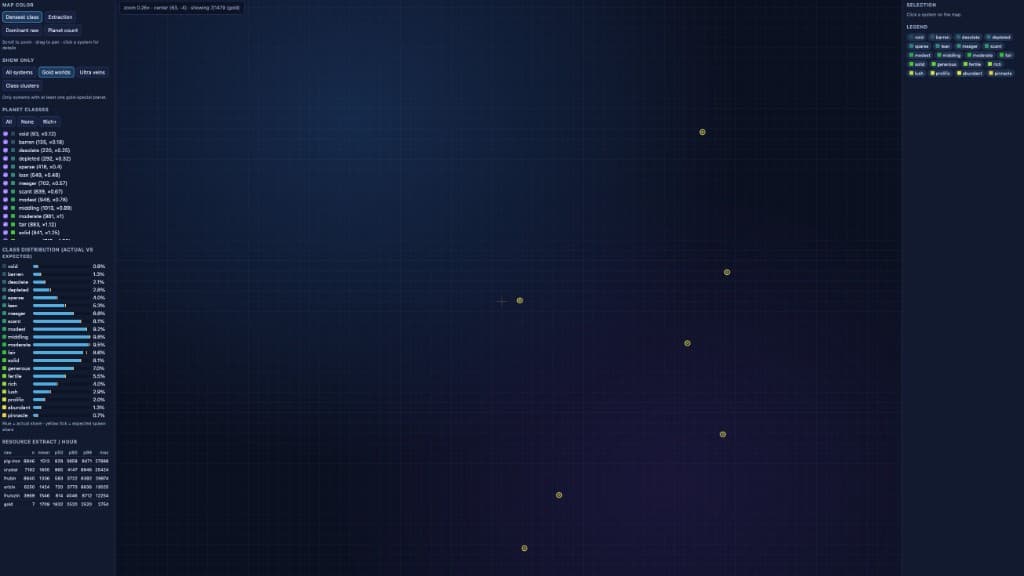
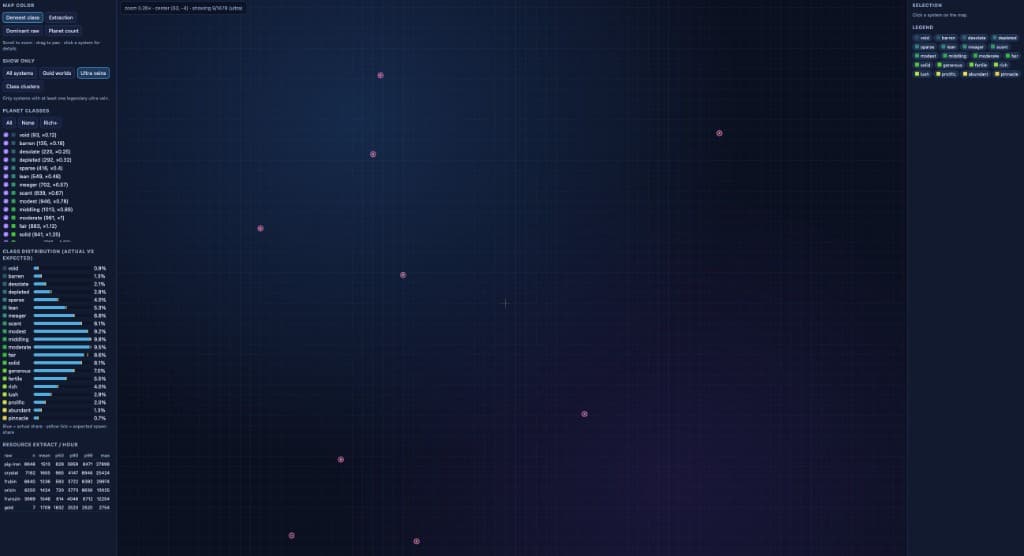
Below is a test generation we use to validate spawn weights and rarity - same generators as live materialization, different seed. Treat the pictures as proof of shape, not as a treasure map of the live round.
The screenshots come from an offline validation pass (~10,000 planets on one test seed). We run tools like this to check class shares, gold-world rarity, and legendary ultra veins before players feel the balance. Your live universe uses the same rules, but a different seed and growing frontier - so positions, counts, and clusters will look different in reality.
Same test map, three lenses
Watch the filter flip from the full field to the needles in the haystack.
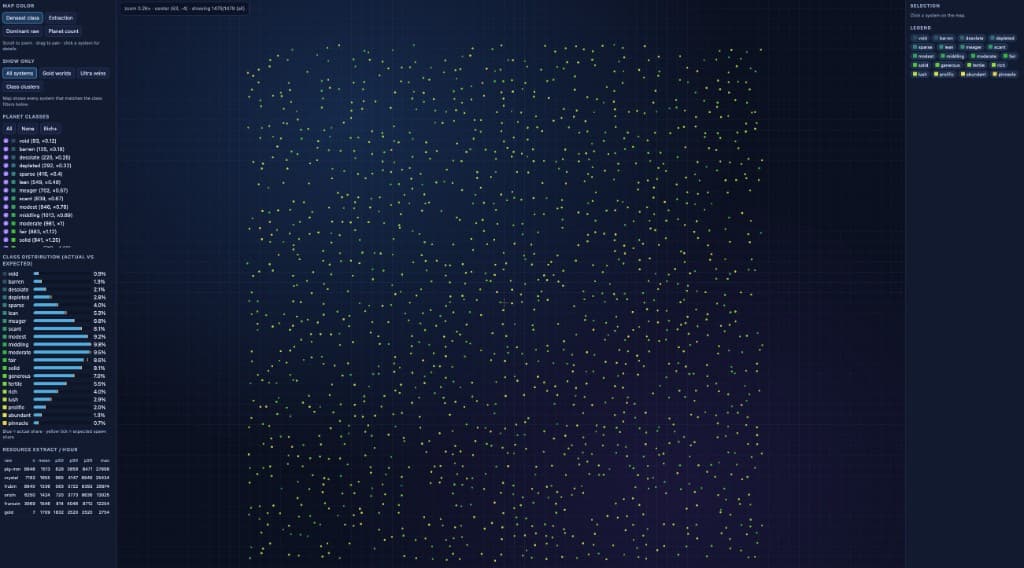
Full field: roughly fifteen hundred systems in this sample - density tiers painted like a weather map.
Auto-cycles · tap a lens to pause, tap it again to resume
Density tiers already stretch from nearly barren void worlds to pinnacle monsters - but even a pinnacle neighbor may lack the ore you need this week. Gold exists only on dedicated gold worlds. Legendary early-ore veins are just as rare. Sitting on three comfortable colonies is a nice economy; it is not a domination plan.
Wide colonization buys optionality: more orbits, more archetypes, more shots at the rare rolls, and more forward bases for fleets. Occupation paint and colonizer hulls turn that optionality into claimed territory - see the colonization path and space occupation docs for the live gates.
The punchline is social as much as geological. Someone has to find the seam. Someone has to haul the surplus. Someone has to hold the corridor. Someone has to publish the star chart so allies (or customers) can meet you halfway.
Fighters make headlines. Empires need a full crew. If your alliance only builds guns, you will starve for ore you never found.
Claim and industrialize many worlds - not just the pretty ones. Blank-slate colonies after the claim timer are the long game.
Contest corridors, escort hauls, and deny rivals the same rare pins you just paid to discover.
Move surplus pig-iron, crystal, and frubin between uneven colonies. Rare worlds mint wealth only if someone ships it.
Shared charts and meeting points turn private recon into alliance knowledge - and a market for what you will not mine yourself.
Lift fog, scan geology, and chase the 0.1% rolls. Without explorers, gold and ultra veins stay rumors on someone else's dossier.
Spread out
Plan for dozens of strategic sites over a round, not a tidy starter bubble forever.
Hunt the 0.1%
Gold worlds and legendary ultra veins are exclusive and rare - exploration and intel are part of the economy.
Build the full stack
Colonisers, fighters, traders, star-map exchanges, and explorers are teammates, not alternate win conditions.
Dig deeper: planet density tiers, colonization path, space occupation.
* Screenshots are from an offline procedural validation tool using production generators - not a live player map export.
* Gold-world spawn is ~0.1% of planet slots; non-gold worlds have no gold extraction. Legendary ultra veins are ~0.1% of planets and never roll on gold or frurozin.
* Star-map exchanges and deep trade loops remain partly roadmap in alpha - the map geometry already rewards the playstyles even while some social tooling is still landing.